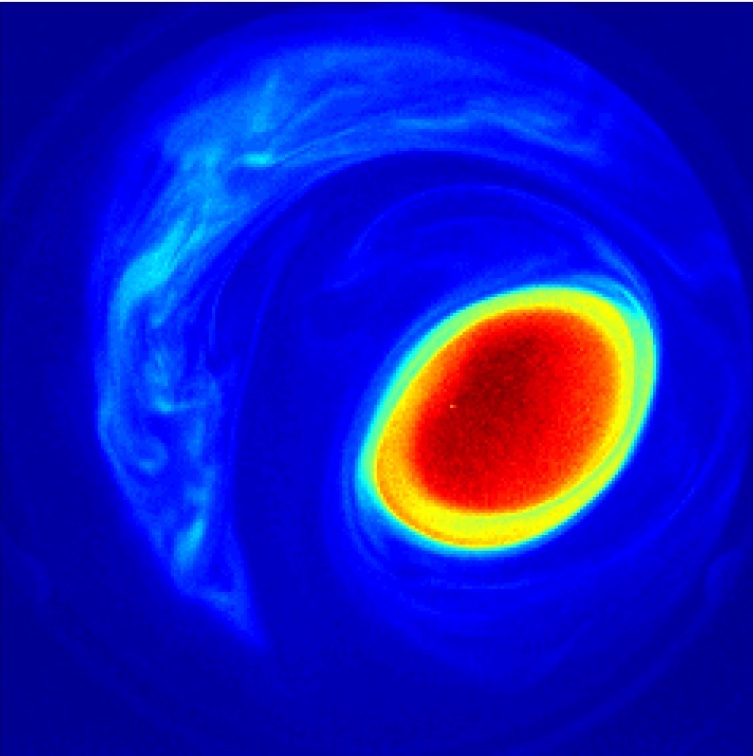
The activity of the group is focused on the experimental and theoretical study of the collective behaviour of plasmas. Our approach is one of fundamental physics, and yet also relevant to applications in fluid dynamics, particle beam dynamics and related investigations about fundamental properties of matter, as well as controlled thermonuclear fusion. We perform our research both on a local scale and within the framework of national and international collaborations.
Research Topics
Nonlinear Dynamics of Non-Neutral Plasmas
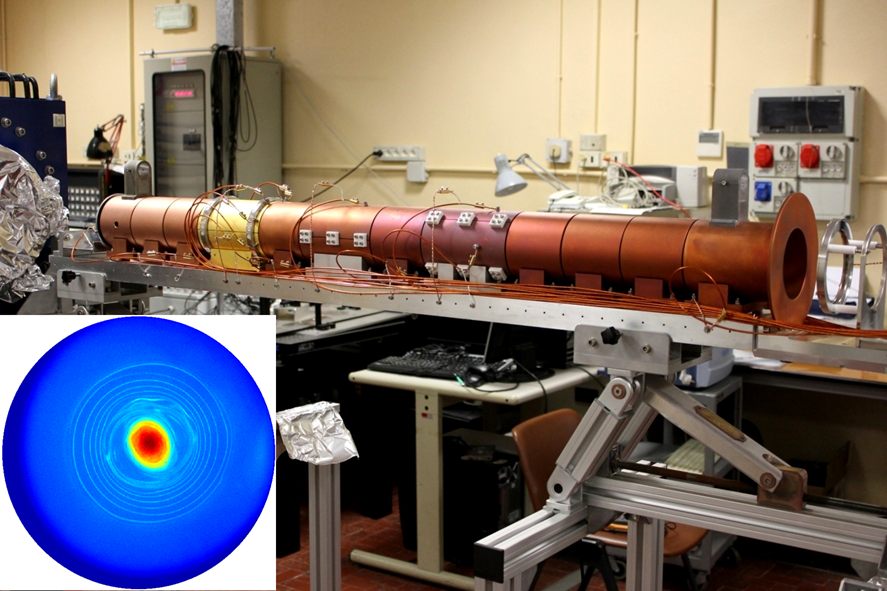
This research line concerns the nonlinear dynamics and the manipulation techniques of nonneutral plasmas and particle beams, with a special focus on the insurgence and control of instabilities, formation of coherent structures, turbulence evolution in fluid systems, control and cooling of charged particle samples. These investigations are of interest to a range of fluid-like collective systems and to the physics and technology of particle beams. The experimental part of these endeavours is carried out in our laboratory in Milano, by means of electromagnetic traps developed by the group and in collaboration with other INFN sections, within projects funded by INFN.
Fusion Plasma Heating
This research line concerns the study of heating and current generation processes by the injection of electromagnetic waves in fusion-relevant plasmas, using and developing ray-tracing and kinetic (Fokker-Planck) numerical codes to describe the plasma response, in collaboration with the Max Planck Institute for Plasma Physics, Germany.
Antimatter Systems
The studies and know-how developed in the field of non-neutral plasma dynamics represent a crucial step in the path to performing precision measurements with a range of interests beyond plasma physics, and especially on antimatter systems. Relevant examples include interferometry measurements on positron and positronium beams – the subject of the national collaboration QUPLAS at the Positron Lab of the Milan Polytechnic – and the experiments concerning the synthesis and spectroscopic measurements on antihydrogen pursued by the international collaboration ASACUSA at CERN’s Antiproton Decelerator, Geneva. The group participates in the QUPLAS and ASACUSA collaborations within the framework of the macroproject LEA (Low-Energy Antimatter) funded by INFN, contributing instrumentation development as well as conception and participation in the experiments.